
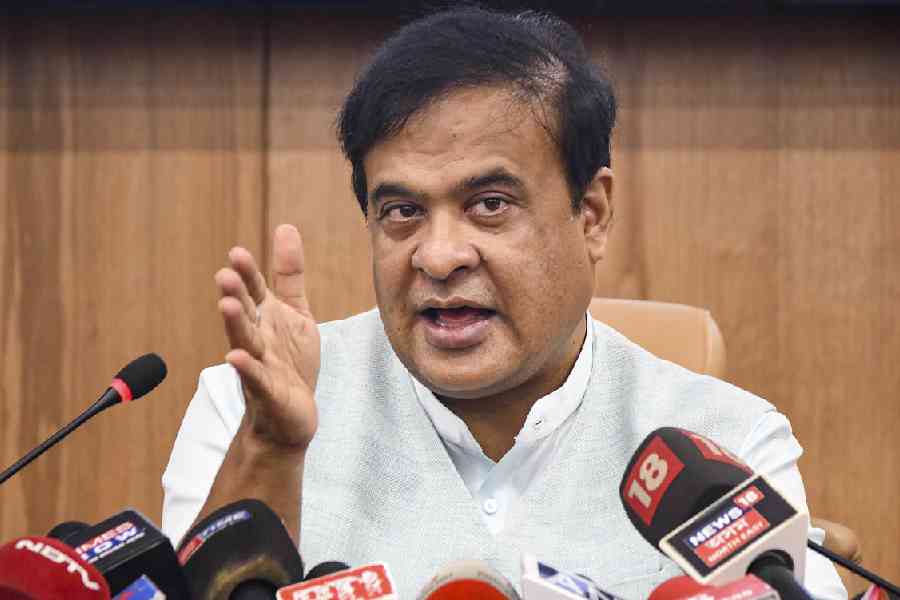
Hemant Biswa Sarma: Continuation of Historical Legacy of Political Cultural Narrative of dominating Order \\ Nishant Anand
Muktosinta, Vol: 10, Issue: 6
“I will not lead Assam become a land of the Miyas”, Himanta Biswa Sarma shared his inflammatory idea in the assembly hall when the house was trying to discuss the gang rape of a 14 year young girl in Nagaon. The opposition parties claimed that CM of Assam is giving a controversial communal angle to this matter, which is detrimental to the social environment of the state. But this was not the first time when Himanta slag off venom against muslim community. In 2021, he remarked that love Jehad is not a hypothetical phenomenon. It is process to convert hindu women to muslim – is a real threat to Hindu society. Himanta used the historical divide between Bengal and Assam, openly call ‘illegal settlers’.
RSS and larger structure of Hindutva nationalism transformed this historical divide of Bengali elite to the ‘Bengali speaking Muslims’. This was the master stroke from the dividing politics perspective of RSS where they ‘kill two birds with a stone’. One, they shifted the total narrative of outsiders to Bengali speaking muslims, which was historically exploited by the Bengali Bhodolok, through occupying important administrative, intellectual posts in Assam. Large expansion of businesses has been run by the Marvari from north India. They were the historical supporter of Hindu-Rashtra because of their class interest and the organisation has dependency on these people for finance & intellectually justify their narrative. Second, they also tried to exploit the void after 1971, the illegal migrant issue from Bangladesh. Majority of the migrants from Bangladesh are of muslim community, who speak Bengali. So, this transformation of the term from ‘outsiders’ to ‘bengali speaking muslim’, it has a larger implication for the RSS.
History is Laying Red Carpet
Assam has been the house of the different tribals for very long. Most of the tribes have some cultural difference in practice. But they have a deep impact of Brahmanical culture on their practice from ancient time, which had intensified in the medieval time of Ahom kingdom, who gave the royal patronage to the Brahmin and Brahmin culture. In ancient time, we found archaeological references of Shaiv sect of 1st century BC. But in the beginning of 4th century AD, Vaishnavite religion took prominence in this area, which can be verified through the worship of Vishnu through literatures of the contemporary time. Till all ancient time, the Assam people had a proper introduction of Brahmanism but the dominating culture was still tribal, with some influences of Aryan culture.
The real transformation of cultural economic practice according to the Brahmanical order of society came during Ahom kingdom. The founder was the supporter of Tai tradition and had good terms. During the time of Sudaangphaa, the Ahom kingdom, started patronising the Brahmanical religion. This sharp tern from tribal tradition to Brahmanical order took place because of the brought-up process of the legal heir. He was trained under a brahmin guru and after coronation, he started giving space to brahmin in administration and other legal fields. The state started practicing the Brahmanical rituals and he took the title of ‘Swargadev’. After this Assamese, which has been developed through Sanskrit language, adopted by the Ahom state.
The advent of Shankardev was remarkable in the history of Assam. When he started a non-vaishnavite religion and criticising the Brahmanical caste practice. He started establishing Satras, a common place for bhajan-kirtan (chanting) and discussion place for all religion, caste, race people. This was challenging for the contemporary Ahom Ruling elites, but not in real sense. The work of Shankardev was somewhere revolved around the idea of devotion towards Lord Vishnu. Majoly a reformist movement against the Brahmanical orthodoxy rituals, which made easy to other tribes to accept the Brahmanical culture. This was the time, when the identity of Assamese started taking a proper shape on the basis of language and cultural practice.
Marking Assamese Identity
Formation of Assamese identity is the expansion of Brahmanism in the Ahom kingdom. The influence of new religion started effecting the nobles and kings too. In the kingship of Jaydhwaj, the first Satra was established in the kingdom. It marked the proliferation of various sects under the big umbrella of Hinduism, which had fully taken its shape in 16-17 century. This was the time, when Assamia language was promoted as court language and Buranji established as proper script. The ultimate formation of the Assamese identity is the proliferation of Neo- Brahmanical order, which worked as a common joining line between ethnic, cultural diversity.
Acceptance of tribal people and culture is very much prominent in Eka Saran Nama Dharma. People from various ethnic groups became disciples of SrimantaSankardev and followed the neo- Vaishnavism cult propounded by him. The tribal cultures of North East India enriched the Sankari culture and it is evident in many aspects of it. Various musical instruments made the common culture of Assam. For Instance, Nagara is designed similarly to a Tiwa instrument known as Ludang-Khram. Another instrument known as Khol innovated by the saint was made by a Kachari artisan from the Kapili valley. The postures of hand and foot movements of Bodo, Karbi, Mising, Jaintia and other tribes are found in Sankari dances.
Those who believe in the nationality development in the Assam on the basis of common language and Culture, they also believe that, the work of Shankardev created a common identity through neo-brahmanical cultural practice. This practice gave some space for the sanskritisation to the different tribal, ethnic identity. Actually, the movement of Shankardev had never tried to destroy the base of the Brahmanical caste order and untouchability. In the middle-ages and till the early part of the 20th century Kaivartas were called Dom and were considered untouchable, therefore, their entry to the temples and Sattras was prohibited. In the early 20th century along with other backward communities, the Kaivartas too led a movement for their upward mobility and to replace the derogatory word Dom with the more respectable word Kaivarta.
Even if we study the decline of Ahom empire, we can easily trace the role of rebellions who tried to usurp the Paik system. The system was the forced bonded labour, which was the base of Ahom’s surplus. The neo-brahmanical order never fought against the tyranny against working people. Like every part of the country, the Bhakti movement was failed to give a stiff struggle against caste order and system from base. This was the reason; these all movements were co-opted by the larger structure of the Brahmanical order. So, the ultimate formation of the Assamese identity was the new tactical production of Brahmanism on the land of Asom.
Dedicated RSS Work and SEVA Model
After the lifting the ban on RSS at national level, the organization had sent a dedicated organiser Thakur Ram Singh. Before singh, the founding stone was led down by the three full time cadres in Guwahati, when the first shakha was established under the leadership of RSS in 1946. In 1975, organization had shakha in every districts of Assam and more than 275 shakhas in overall north-east. The 1950 earthquake gave them an opportunity to enter in the society of Assam through Seva(help). RSS was supported by the local merchants which were dominatingly from Marwari community. The funds were channelise to initiate relief drive all Assam. Dominatingly, the image of RSS was an upper caste organization, under the idea of Brahmanism till 1950. But after that, the tactics of SEVA, gave them the access to the tribal, women, Dalits of the community. The community service in the crisis created an immediate memory that the only organization came in front to save the lives of the citizens. The concept of seva was never detached with the idea of humanitarian intervention in the Assam’s culture which had shaped under the idea of Shankar’s neo-brahmanical understanding. Where seva is directly related to the Punya(virtue), the greater virtue from the perspective of immediate relief and gives the authority to order something.
The less developed democratic consciousness and dominatingly guiding by the medieval administrative system have been used by the RSS to build a cult-based society under the supreme order of Hindu religion and SEVA. This huge relief drive made easy to contact with the affluent persons of the different districts, who helped to consolidate the organisation further. Sangh helped to find jobs to the hindu migrants who came to india after partition. During Emergency period, Sangha organised the Assamese people and Maitei community against the tyrant of Indira. These all works made a different perception towards Sangha.
Ruling Class has consolidation on the idea of ‘New Outsiders’
Sitanath Brahmachoudhury, the Assam Sahitya Sabha President of the 1981-82 session, would qualify the peasants with roots in Mymensingh as matiluviya (land-hungry). 1970s-80s was the time, when the definition of outsiders was getting narrower in assam and it concentralized around Bengali speaking Muslims. Where Frantz Fanon marked the base of intellectual alienation on the middle-class society, there is a different perspective to see this alienation or is it alienation actually? The support of the intellectuals to supress the Bengali speaking muslim was and is their class interest. The ruling class and upper rang of middle class are in the position to claim land. The idea of Matiluviya itself a claim of ruling class in the area, which has shifted the enemy from outsiders in totality to particular Bengali speaking muslims.
The wage of indigenousness has never been paid to the indigenous Assamese local tribes. Tribal groups like Misings have always been used by the caste Assamese to show the diversity of Assamese culture but they have never been fully integrated into the manifold of Assamese society. The economic, social condition of the Mising community is pathetic but the caste Hindu gives them a false assurance of Indigenous and feel their mind with the hatred against Muslims. More than 32% of the overall population of Assam is Muslim. The Bengali speaking Muslims are majority in number, and holds a fraction of land in this state. But the narrative of fear to be marginalised has engulfed in the mind of lower rang of the society.
MS Prabhakara, a former Assam correspondent for The Hindu, wrote back in 2009 that, in essence, “these movements of ethno-nationalism are no different from Hindutva movements that too are animated by fear and hatred of the ‘Other’”—of bahiragata, primarily understood as “outsiders” of Bengali origin, in the case of the former, and of Muslims in the case of the latter. “Hence, too, the phenomenon of ethnic cleansing that is as much an integral part of such ethno-nationalist assertion as of the Hindutva movements.”
So, the new outsider is the creation of the current ruling order to sustain its ruling position. But on the other side, ruling class is giving open hands to the ‘private outsider companies’ and giving lands to exploit the resources of the state. The recent example, the land given to the Ramdev Baba and one foreign firm to produce palm oil on the land of rice cultivating region. The palm oil is the worst kind of oil which has been resisted by the western society because of its health-related hazard. The Himanta government has given an open hand to the private players to acquire the lands on cheap price. According to the recent acquisition rule for the oil exploration on private land, the government will give 12 lakhs per bigha for the lands which are in the radius of ten kilometres of the city and 10 lakhs per bigha to the rural areas. The amount committed by the government will permanently displace the person because in future they will be able to buy the land again. This onslaught of neo-liberalism is open and blunt, but it is in the interest of Assamese elite ruling system, and that’s why there is no cry for outsiders against them.
‘Us’ v ‘Them’
The politics of Himanta Bishwa Sarma is revolved around the narrative of ‘Us’ v ‘Them’. Where Us is Hindu community and ‘Them’ is Muslim. The BJP government has been gathering praise all around the country’s middle class because of their strategy of encounter. This strategy gives an instant justice and also establishing the idea in the mind of the larger masses. Opposition leaders claim that last fifteen incidences of encounter, there is only one thing common is the accused were of the Muslim community. This not a coincidence that
When BJP government decided to introduce Himanta over Sonowal, Kaushik Deka, senior editor of India Today magazine that the “unprecedented move” demonstrated “the importance of Sarma not only in the politics of Assam and the Northeast, but also in the larger game plan of the BJP and its ‘ideological fountainhead’ the RashtriyaSwayamsevakSangh.” Deka listed factors that worked in Sarma’s favour: his family’s long association with the RSS, his steadfast vow to its ideology and his vocal support of the CAA, an RSS creation.
The ardent follower of sangha, Himanta has a clear perspective, whatever happens in Assam, he must target the Muslims. For Sarma, it is not Bangladeshi muslim, who is bull’s eye but the overall community is. In the election campaign for the state legislative assembly Sarma revealed that “These so-called Miya people are very communal, very fundamental and they are involved in various activities to distort Assamese culture, Assamese language. So, I don’t want to be MLA with their vote.”
But few of the intellectuals like Udayon Misra, Assamese academic, characterised that result as a victory for identity politics, not Hindutva. He emphasised that the BJP won the election because they smartly used the identity question and draw connecting lines with the demands and appeal. Where BJP used identities like mati, bheti and jati; Ahom kingdom’s victory over Mughals and so on. Here, Udayon missed the eagle’s eye of the whole structure that, in Assam these all identity have been historically co-opted by the Brahmanical order and understanding. Misra also misinterpreted the functioning of AASU (All Assam Student Union) and find it on a nationalist struggle basis. After the derailment of the national struggle in Assam, the leadership and nature of AASU has been changing with the power dynamics of the state. Biggest example is Himanta Biswa Sarma, previously was the member of AASU. AASU has hardly fought a single struggle late 90s in the interest of national bourgeoise of Assam. How could Misra claim it as nationalist student organization?
The success of RSS has two big factors. One, the dedicated and tireless efforts of the Sangha for their goal and expansion. And second, the weak political struggle of the opposition including left parties of Assam. It is high time to introspect the intellectuals of Assam to understand their correct position from the broader perspective of democratisation of the society, rather than the sectarian interest, where RSS has already drawn the historical parallel of Hindutva.
