
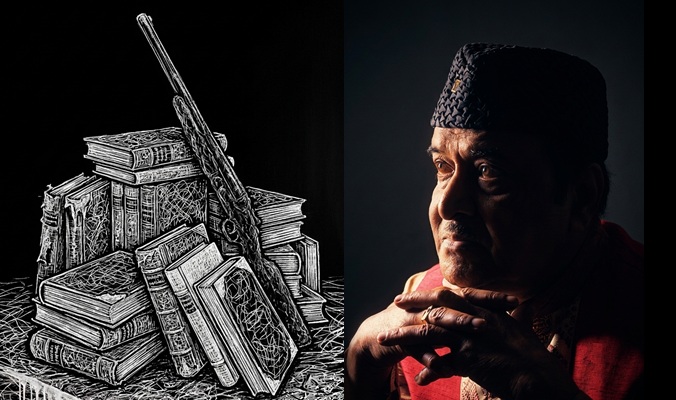
The Personal and the Political in Bhupen Hazarika’s Songs।। Prachee Dewri
Mukto Sinta XII : I
মোৰ গীতৰ হেজাৰ শ্ৰোতা!
তোমাক নমস্কাৰ!
গীতৰ সভাত তুমিয়েতো প্ৰধান অলংকাৰ।
Thousand listeners of my songs!
My greetings to you!
In a music concert, you are the prime ornament.
Bhupen Hazarika’s music reveals a very intimate and dynamic relationship with the people of Assam. His music has given us glimpses into the everyday joys and sorrows of the people of the region and has borne witness to almost every significant moment in the collective lives of the people of the region. In his melodies one hears the echoes of the music of the various communities of the region, blended with Western music. On the other hand, some of his songs turn inwards, to explore the deep personal emotions and dilemmas of an artist. However, Hazarika’s life was like a meandering river, with perplexing contradictions and shifts in political ideology, which makes it very difficult to define and sum up who he was. This essay is an attempt to understand his aesthetics and his politics through his songs.
Perhaps one will have to begin with his formative years, when his musical and political consciousness was shaped. Bhupen Hazarika was born in 1926 in Sadiya in a family where both his parents were culturally and musically inclined. His father, Nilkanta Hazarika was a music lover who also composed songs. His mother used to sing Borgit, kirtan ghosa and other Asamiya folk forms of music. By the 1930s, he came in contact with Jyotiprasad Agarwala and Bishnuprasad Rava. Agarwala and Rava honed Hazarika’s musical talent and took him to the studios in Kolkata to record their compositions in his voice. From lending his voice to the female characters in Agarwala’s audio-plays Joymoti and Sonit Kunwori, Hazarika went on to record songs such as “Kashote Kolosi Loi” and “Ulahere Nasi Bagi Holi Biyakul.”
This association with Agarwala and Rava shaped his politics and aesthetic as well. The early and mid-twentieth century was a period of great upheaval in the world of art. The Bolshevik Revolution brought in the force of the working class and peasants to oppose capitalism and inspired many artists across the world. The rise of fascism in the 1920s, and the resistance to fascism compelled artists to take political stands. When the Spanish Civil War broke out in 1936, the progressive writers of the world volunteered to fight for the Republicans against the fascist forces of Francisco Franco. Writers in colonised India too responded to the anti-fascist efforts by forming the All India Progressive Writer’s Association (PWA) in 1936 (Pradhan 1: x). Performing artists of India formed the Indian People’s Theatre Association (IPTA) in 1943. The Assam branch of the IPTA was formed in 1947 through the efforts of Hemango Biswas, with Jyotiprasad Agarwala as the President and Rava as the Vice President.
These political upheavals sparked debates about the role of art and the artist in society. In Assam too, artists formulated their theories on the role of art in society. These views shaped Bhupen Hazarika’s artistic consciousness. In one of his interviews with Amarjyoti Choudhury, Hazarika describes the philosophies of Agarwala and Rava in the following way—Rava’s consciousness traversed close to the soil, whereas Agarwala’s consciousness floated above the soil but never quite lost touch with it. These two slightly different perspectives seemed to complement each other, and shaped Hazarika’s aesthetics. Thus, his songs sometimes carry very vivid descriptions of the lived realities of the people who till the soil. At other times they traverse abstract ideals such as justice, humanity, compassion, which float slightly above the soil, but are very pertinent to the lives of the downtrodden, the have-nots (sorbohara).
One of the first songs that Hazarika composed was “Agni Jugor Phiringoti Moi”, which he wrote in 1939, when he was about fourteen years old:
অগ্নিযুগৰ ফিৰিঙতি মই
নতুন ভাৰত গঢ়িম।
সৰ্ব্বহাৰাৰ সৰ্ব্বস্ব
পুনৰ ফিৰাই আনিম
I am the spark of the age of fire
I’ll create a new Bharat
I will bring back everything
To the hands of the have-nots.
This concern for the have-nots (sorbohara) found more expression in his songs when he came in contact with the IPTA. When the Assam branch of the IPTA was established in 1948, Hazarika was doing his BA and MA in Political Science in Benaras Hindu University, after which he went to Columbia University and acquired his Ph. D. in Mass Communication in 1952. During his stay there, he met Paul Robeson and was greatly influenced by his music. It is a well-known fact that the song “Bistirno Parore” (1965) is inspired by Robeson’s “Ol’ Man River”. When Hazarika came back to Assam in 1953, he became an active member of the IPTA. He was the secretary of the Reception Committee of the third All Assam Conference of IPTA held in Guwahati in 1955.
His aesthetics during this period was beautifully summed up in the song “Osto Akashore”, where he attempts to convey that the true purpose of an artist is to portray the joys and sorrows of the people. In the song, he conjures the image of an artist who is sailing on a boat on the mighty Luit (Brahmaputra), painting the crimson sunset, immersed in the world of art for art’s sake.
কোন সুন্দৰৰে শিল্পীয়ে
পদুম ফুলৰ নাৱেৰে
ময়ুৰ পংখী ৰহণবোৰ দিয়ে ছটিয়াই।
Which painter of beauty
On his lotus-boat
Sprinkles the colours of the peacock feather?
He then urges this artist to turn his gaze towards the shores of the Luit, because people, their everyday joys and sorrows are the true source of meaningful art:
দুয়োপাৰে কত মানুহ কত যে ইতিহাস
কত যুগৰ শত আশা নিৰাশাৰে নিশ্বাস।
লক্ষ্য যদি দিগন্ত, শিল্পী হে তোমাৰ,
পদুমৰে পানচৈ চপোৱা এবাৰ
দেখিবা জীৱনৰে দিগন্ত অপাৰ
On both the banks
So many people, so many histories
So many sighs of a hundred hopes
And countless disappointments
Of countless ages
O artist, if your destination is the horizon
Steer your lotus-boat to the banks for a while
You will see the endless horizon of life
Indeed, living up to his appeal to all artists, Hazarika steered his own boat towards the banks of the Brahmaputra. Many of his songs are stories carved out of the everyday lives and struggles of the people living on the banks of the river. One such story is “Porohi Puwate Tulunga Nawote” (1954), which tells us about Rongmon, who goes out in a little boat to fish in the turbulent river despite warnings of an impending storm. The listeners are filled with dread as the narrator warns him, “There is no need to go fishing, there is a storm coming.” Rongmon does not return, and his wife begins to panic:
হিয়াখনি ভুকুৱাই আকাশলৈ চাই চাই
ৰহদৈ বাউলী হ’ল
অ’ ঢৌ যা গুচি নিশাকে নেওচি
ৰংমনক আনিবৰ হ’ল।
Beating her bosom, looking up at the sky,
Rohdoi lost her mind!
Oh waves, go away! Braving the dark night!
It’s time to bring Rongmon home!
Almost as if in response to her pleas, the waves carry Rongmon’s body to the shore. This song brings alive the turbulent relationship between man and the river in Assam, where the river sustains life, but also destroys it, in cycle of destruction and rejuvenation.
Through his songs, Hazarika bore witness to many historical changes in Assam and the North East. Sometimes his songs expressed the unarticulated collective emotions of the people. Sometimes they helped people to understand their own reaction to events. And sometimes, he inserted his own voice to intervene and make a political statement. Whether one agreed with him or not, such songs helped to begin a conversation, it helped to preserve a memory of a historical event. There are very few historical moments in the region during the late twentieth century, which are not commemorated by his songs.
For instance, the separation of Meghalaya from Undivided-Assam in 1972 is indelibly etched in the minds of the people of Assam by the delightful and wistful song addressed to Ms. Monalisa Lyngdoh of Shillong. The separation of Meghalaya from Assam came after a long period of struggle for self-determination among the Khasi, Jaintia and Garo communities, and a long-drawn hostility between the locals of Meghalaya and the Assamese. This song is a love story of a Khasi woman and an Assamese man who are sundered apart because of the separation of Assam and Meghalaya:
তুমি আজি লাবানৰ কৰবাত
আৰু ৰাজধানী সলনিৰ পিছত আহি
হ’লোঁ এতিয়া দিছপুৰীয়া
Today you are somewhere in Laban
And after the shifting of the capital city,
I have become a Dispur man!
It is an allegory which helped the communities on both sides to make sense of the separation. The song also provides hope of a possible reconciliation. The Assamese lover hopes to meet Monalisa at Nongpoh, the mid-point between Dispur and Shillong and says:
মনালিছা, নংপোলৈ
এবাৰ আহাঁ না
আৰু মইও যাম ছুটী পালে নংপোলৈ
মন দিম মন নিম
গীটাৰৰ সুৰে সুৰে
অদুৰ মধুৰ কোনোবা ৰাতিপুৱা।
Monalisa,
Please come to Nongpoh, just once
I’ll also go to Nongpoh when I get some leave.
To the melody of the guitar,
We will give each other our hearts
On a lovely morning not too far away
Metaphorically, this could mean the possibility that the people of the two states might one day be able to forget the hostilities and meet each other halfway. Till this day, the small town of Nongpoh—where travellers stop to refresh themselves on the way from Dispur/Guwahati to Shillong and vice-versa—evokes a sense of romance and wistful longing for reconciliation.
Hazarika joined the efforts by artists to bring back peace and harmony during the linguistic conflict between Bangla-speaking and Asamiya-speaking communities in 1960. Although this was an old conflict which had its beginnings in the nineteenth century, it had turned violent in 1960, causing great terror among Bengali-speaking people in Assam. When the conflict escalated in 1960, the IPTA mobilised many artists of the region under the banner of the “Let us Meet Cultural Troupe” to counter the divisive forces.
One of the famous songs associated with the “Let us Meet Cultural Troupe” was a duet sung by Hemango Biswas and Bhupen Hazarika, called “Haradhon Rongmon Kotha”, which is a heart-rending conversation between a migrant East Bengali peasant Haradhon and an Asamiya peasant Rongmon about the conflict between Bengali and Assamese people over land (Biswas 965-7). In this song, Hemango Biswas sings a Bhatiali tune, while Bhupen Hazarika sings a Bihu tune. They engage in a conversation through these two forms of music. The conversation is a lament about the tragic circumstances that led the Assamese to become hostile towards the East Bengali peasant who was initially welcomed into the valley. The song goes on to celebrate the universal human nature and emotions such as love and sorrow that bring people together despite linguistic boundaries.
However, there have been a lot of shifts in Hazarika’s ideological stand over the years. Although he called for peace between Bengali-speaking and Asamiya-speaking people in the 1960s, in the 1980s, he wrote many songs in support of the Assam Movement, mobilizing mass support for the movement, such as “Shwohid Pronamu Tomak” and “Tez Dila Pran Dila Tyag Dila Deka Bondhu”. This shift finally culminated in his contestation for the Lok Sabha seat with a BJP ticket.
A question that emerges when one talks about the relationship between the artist and the people is, what constitutes the term “people”? In a heterogenous country like India, and especially a semi-feudal and semi-tribal state like Assam, it is difficult to define the term people. Because of the complexities of class, caste, gender, religion and ethnicity, “people” is a very complex category which requires a very nuanced stance. There is a push and pull between the international, national and regional allegiances in Hazarika’s creations. He was unable to reconcile these contradictions, and towards the latter part of his life, tended to lean towards the regional, national and chauvinistic. This has led to a sense of confusion and betrayal among many of his listeners.
To understand these changing ideological stances, one can look for hints in his more personal, self-reflective songs. Listeners often treat these songs as separate from his political songs. But to truly understand an artist, one needs to look at every aspect of their art. At the very least, these songs make us realise that the artist is after all, human. In several songs, Hazarika explores the inner contradictions of the artist. He almost treats his listeners as confidantes to whom he can bare his soul. The song “Akashi Ganga Bisora Nai” (1963) expresses the loneliness of the artist. He speaks about the sense of loneliness in a crowd, and the search for a true companion:
হয়তো নিতৌ হেজাৰ জনৰ
হেজাৰ শৰাই পাওঁ
তথাপি কিয় বিশেষ জনৰ
মৰম বিচাৰি যাওঁ।
It’s true that every day
I receive a thousand accolades
Yet why do I continue to search
For the love of someone special
There is a push and pull between the private and the public, the personal and the political in this song. Yet another song reveals the same push and pull—”Bimurto Mor Nishati” (1971). Although it is predominantly a song about an intimate moment among lovers, and although it might not be an autobiographical song, one line jumps out as a comment on the relationship between an artist and the people:
দুৰৈৰ আৰ্তনাদৰ নদীত
ক্ৰন্দন কোনো ঘাটৰ
ভ্ৰুক্ষেপ নাই লভিছোঁ মই
আলিংগনৰ সাদৰ।
Far away in the river of laments,
One hears cries from the shores;
I don’t spare a single glance,
I am partaking of the sea of embraces.
Social commitment in an artist, especially one who has a mass appeal like Bhupen Hazarika, is a constant push and pull between personal needs, self-interest and political commitment. These contradictions are further magnified when they are set against a socio-economic context marked by ethnic and communal tensions and a neo-liberal economy.
The fact that Bhupen Hazarika was aware of these contradictions can be gauged from the song “Mor Geetor Hezar Shrota” (1973). In this simple and joyful song, he expresses gratitude to his listeners for recognising his talent and keeping them in their hearts. Indeed, Bhupen Hazarika, who has been recording songs since his childhood, have been nurtured by his audiences. He goes on to acknowledge that he is not free of fault, and opens himself up to the criticism of his listeners:
ভুল যদি হয় সৃষ্টিত মোৰ,
তুমি হোৱা চিন্তিত
সমালোচনাৰ অগনিৰে পুৰি
মোকো কৰা উন্নত।
If there are any mistakes in my creations,
You become concerned
You burn me with the fire of criticism
And raise me up to greater heights
It is this candidness that makes him so dear to all his listeners. Over the years, Bhupen Hazarika formed a strong bond with his listeners. He entered the world of his listeners as a young talented boy with great potential. As an adult in the 1950s and 60s, he emerged as a powerful voice of the oppressed, deprived and marginalised people. Children who grew up in the 1950s and 60s looked up to him as a hero. As he grew older, his politics became murkier, but he continued to bear witness to socio-political changes in the region. Perhaps Bhupen Hazarika was not a hero who could bring about political change, but his songs are powerful and continue to be relevant till this day. And his voice is deeply familiar to his listeners, fallible, yet expressive and eloquent.
